
If you’re constantly juggling classes, part-time work, assignments, and a social life, then you know how challenging it can be to keep your academic performance on track. The secret isn’t studying more—it’s studying better. When you adopt strategies that make learning more efficient, you’ll find yourself saving time and getting better results without the added stress. This article walks you through a series of practical, research-backed techniques you can apply right away to get more out of every study session. These methods are built for your packed schedule and designed to help you get ahead without burning out.
Make Active Recall Your Go-To Method
One of the biggest mistakes you can make is reading your notes over and over, thinking repetition equals retention. Instead, shift to active recall. This technique involves pulling information out of your brain without looking at the material first. That struggle to remember actually strengthens your memory, helping you retain facts for longer.
You can start using active recall by closing your notebook and writing down everything you remember about a topic. Then, check your accuracy and fill in the gaps. This shows you where you’re solid and highlights what you still need to work on. Apps like Anki and Quizlet are built around this method and let you carry practice sessions in your pocket. You’ll find yourself memorizing faster and forgetting less.
Use Spaced Repetition to Fight Forgetting
If you’ve ever crammed the night before and forgotten everything a week later, you’ve run into the forgetting curve. That’s where spaced repetition comes in. Instead of reviewing a topic just once or twice, you revisit it over time—right before your brain is about to forget it.
This method works because each time you review the material, your brain works a little harder to retrieve it, reinforcing that memory. Plan short review sessions over several days or weeks rather than reviewing everything in one sitting. You can automate this with digital flashcards or schedule it yourself with a planner. It’s not just about repetition—it’s about timing it right.
Block Distractions With the Pomodoro Technique
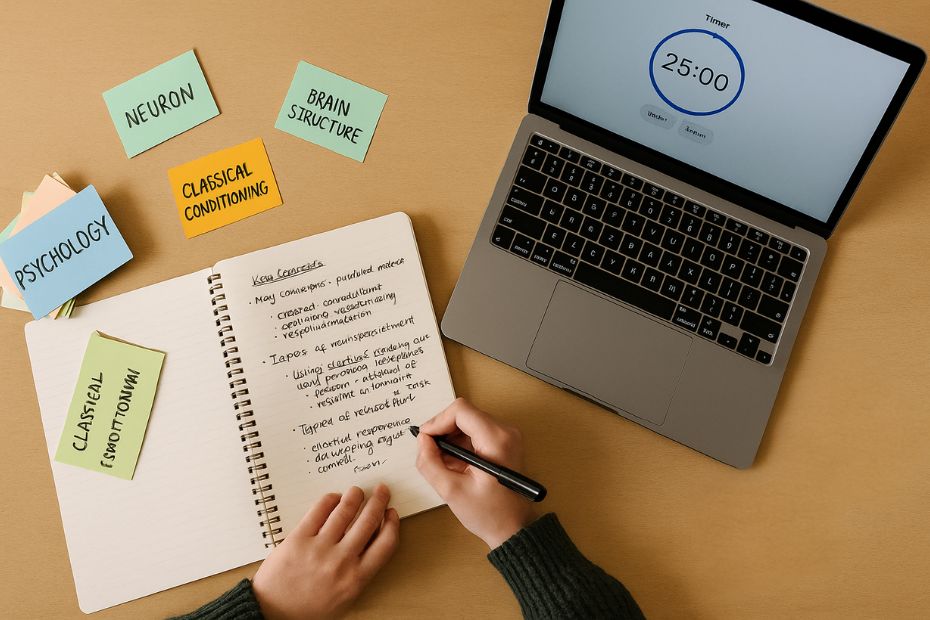
You don’t need six uninterrupted hours to study effectively. What you need are short, focused bursts of work. That’s the idea behind the Pomodoro Technique. Set a timer for 25 minutes, focus entirely on your task, then take a 5-minute break. After four rounds, take a longer 15–30-minute break to reset.
This method helps you stay productive without overwhelming your brain. Use your break to get up, stretch, grab a snack, or breathe fresh air. During your 25-minute sprint, put your phone on silent or use apps like Forest or Freedom to block social media. You’ll be surprised how much you can get done when you eliminate distractions and work within a deadline.
Explain It to Learn It
You can study a concept for hours, but if you can’t explain it simply, you probably don’t understand it fully. Teaching forces you to process information in a way that makes sense to others, and that’s exactly what helps it stick in your brain. This strategy—sometimes called the Feynman Technique—is a favorite among high-achievers.
Try explaining a topic out loud to yourself or a classmate as if they know nothing about it. Avoid jargon and keep your explanation simple. If you get stuck, you’ve just found a weak spot in your understanding. Go back to that section and review it before trying again. The more you practice explaining, the more clearly you’ll think.
Create Mind Maps and Visual Tools
Visual aids can help you absorb complex material faster. When you use diagrams, charts, or mind maps, you’re organizing the information in a way your brain finds easier to remember. This technique works especially well for subjects with multiple layers or interconnected concepts, like biology or political science.
Start with a blank sheet of paper and put your main topic in the center. Then branch out into key subtopics and supporting facts. Add arrows, colors, or images to make it more engaging. You’re not just creating a study tool—you’re actively interacting with the material. That alone helps reinforce what you’ve learned.
Focus on the Hard Stuff First
Your brain has peak hours. For most people, that’s earlier in the day or right after a good rest. Use those windows to handle your toughest subjects. Don’t leave them for late at night when your energy is drained. Tackling complex material when your mind is fresh means you’ll learn more in less time.
Organize your schedule so that your most demanding work is done when you’re at your best. Use lighter tasks—like reviewing flashcards or tidying your notes—for times when your focus isn’t as sharp. This ensures you’re working with your brain, not against it.
Break Big Goals Into Small Wins
Trying to study an entire textbook in one sitting is not just unrealistic—it’s demoralizing. Instead, break large assignments into manageable tasks. Focus on finishing a single chapter, solving five problems, or reviewing one topic per session. This makes your workload feel more achievable and keeps you motivated to keep going.
Use a study planner or to-do list to track your goals. Every time you check something off, your brain gets a small reward. That sense of progress helps you stay on track, especially when things get busy. Over time, those small wins stack up and lead to major results.
Stay Active and Sleep on It
You already know sleep is important, but don’t overlook how powerful it is for memory. During sleep, your brain consolidates new information, helping you recall it more clearly later. If you’re pulling late nights and waking up groggy, you’re hurting your ability to learn.
Aim for at least 7 hours of sleep a night, especially before exams or long study sessions. Combine that with physical activity—even short walks—to boost energy and focus. A well-rested and active brain is far better at problem-solving and critical thinking than one running on coffee and three hours of sleep.
Don’t Multitask—Work With Intention
Trying to study while watching YouTube or checking messages won’t help you absorb anything. Your brain can’t process two active tasks at once—it’s just switching between them, and that switch wastes time and energy. The better strategy is monotasking: doing one thing at a time with your full attention.
Before you start studying, clear away anything unrelated to the task at hand. Set a goal for your session and stick to it. When you give your full attention to the material, you’ll study faster, make fewer errors, and retain more. Quality beats quantity every time.
Top Strategies to Study Smarter
- Use active recall
- Space out review sessions
- Study in timed intervals
- Teach what you learn
- Use mind maps
- Focus on difficult topics early
- Break big tasks into small goals
In Conclusion
Studying smarter isn’t about finding shortcuts—it’s about using your time and energy more effectively. When you incorporate strategies like active recall, spaced repetition, time-blocked focus, and task prioritization, you turn every study session into real progress. These tools help you earn better grades and reduce burnout and boost confidence. You don’t need to study longer—you need to study with a plan that works for your life. Stick with it, and you’ll get more done, remember more, and still have time left for the rest of your university experience.
Did these strategies resonate with you? Discover more useful content and join the conversation on my Blogspot.