
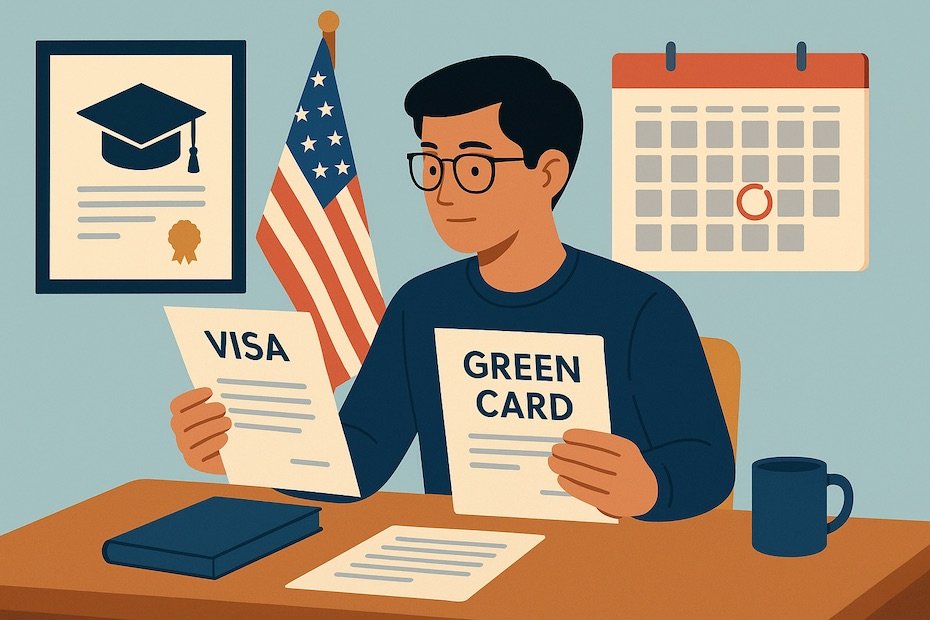
You can transition from an F-1 student visa to a green card through employment, family sponsorship, or self-petition if you meet the eligibility criteria.
This article guides you through the most strategic immigration pathways available to international students after graduation. You’ll learn which visa types align with your career, how to avoid delays, and what to expect at each stage of your transition to permanent residency.
What are the main green card options after graduating on an F-1 visa?
You have four primary pathways: employment-based sponsorship (EB-2, EB-3), family-based sponsorship (marriage or immediate relative), self-petition under EB-1A or EB-2 NIW, and investment-based green cards (EB-5).
Most international graduates begin with OPT or STEM OPT, then transition to an H-1B visa. From there, if an employer is willing, they file a PERM labor certification followed by an I-140 petition. Alternatively, if you marry a U.S. citizen, you can bypass employment-based routes and apply through family sponsorship.
High-achieving students in science, technology, or public interest fields often pursue the EB-2 National Interest Waiver (NIW). This route removes the employer requirement and is ideal if your work benefits the U.S. on a national level. EB-5 is rare due to the $800,000+ capital requirement, but it’s an option for well-funded entrepreneurs.
Can I stay in the U.S. after graduation while applying for a green card?
Yes, you can remain in the U.S. on OPT, STEM OPT, or H-1B while starting a green card process. These visas give you lawful presence and work authorization.
After completing your degree, you’ll get up to 12 months of OPT. If your major qualifies under the DHS-approved STEM list, you can apply for a 24-month extension. During this period, you should seek employment that matches your degree and aligns with sponsorship opportunities.
H-1B is the most stable bridge to a green card. It allows dual intent, meaning you can legally remain in the U.S. while a green card petition is pending. If selected in the H-1B lottery, you gain three years (extendable to six) of authorized employment—enough time to complete the green card process.
What’s the difference between EB-2 and EB-3 for international graduates?
EB-2 is reserved for individuals with advanced degrees or exceptional ability. EB-3 is more commonly used by bachelor’s degree holders and skilled workers.
If you earned a master’s or Ph.D. in the U.S., EB-2 may be your best route. It typically involves faster processing—especially if you qualify for a National Interest Waiver. EB-2 NIW lets you skip the PERM labor certification, removing the employer from the equation entirely.
EB-3 is employer-driven and slower due to the required labor certification. It’s appropriate for students with bachelor’s degrees and at least two years of relevant work experience. For many graduates, it becomes the default option if their employer is not pursuing the EB-2 category.
Do I need an H-1B to apply for a green card?
No, an H-1B is not required—but it is the most common and legally secure path for recent graduates working in the U.S.
Filing for a green card directly from F-1 is risky because F-1 is a non-immigrant intent visa. Attempting to adjust status while on F-1 may raise red flags unless done through a transition to a dual-intent visa first, like H-1B or O-1.
The benefit of H-1B is that it buys you time. If your employer starts the green card process while you’re on H-1B, you can remain employed in the U.S. until your priority date becomes current—even if that takes several years.
How does marriage to a U.S. citizen affect my immigration path?
Marriage to a U.S. citizen allows you to apply for a green card through adjustment of status without needing a temporary work visa or employer sponsor.
If you’re currently on F-1 and get married to a U.S. citizen, you can file Form I-130 and I-485 simultaneously. This initiates the adjustment process, and you can also apply for work and travel authorization (EAD and Advance Parole) while you wait.
The processing time varies but averages 12–18 months. Immigration officials will closely evaluate the legitimacy of the marriage, so prepare documentation like shared leases, joint bank accounts, and travel history.
Can international students apply for a green card through self-petition?
Yes, if you meet the qualifications for EB-1A (extraordinary ability) or EB-2 National Interest Waiver (NIW), you may petition without an employer.
The EB-1A category requires proof of exceptional talent demonstrated through major awards, media coverage, original contributions, or scholarly authorship. It’s the most selective self-petition route.
The EB-2 NIW is more attainable for STEM graduates and researchers whose work benefits U.S. national interests. If you’re publishing in respected journals, leading innovation in energy, healthcare, or artificial intelligence, this could be your most flexible option.
What are the most common mistakes to avoid when moving from F-1 to green card?
Timing errors, visa misunderstandings, and employer inexperience are among the most frequent mistakes international students make during this process.
Many wait too long to initiate the green card process, assuming OPT or H-1B gives unlimited time. Others select employers who aren’t familiar with immigration requirements, causing delays or errors during the PERM certification phase.
Some also forget that F-1 is not dual intent. If you submit green card paperwork too early while still on F-1, you risk denial for violating the visa’s non-immigrant intent clause.
To prevent setbacks, ensure you:
- Start green card planning in your final academic year
- Choose an employer experienced in immigration processes
- Monitor visa timelines and expiration dates accurately
- Prepare documents early for PERM and I-140 filing
- Avoid any period of unauthorized employment or unlawful presence
How long does it take to get a green card after graduation?
Processing times vary based on visa type and your country of origin. It could take 1–2 years or 10+ years depending on the backlog.
The EB-2 and EB-3 categories are subject to the Visa Bulletin, which is updated monthly. If you’re from India or China, wait times are significantly longer due to annual country caps. Marriage-based green cards, on the other hand, are processed much faster—often under 18 months.
The green card timeline includes: PERM labor certification (6–12 months), I-140 approval (4–10 months), and either adjustment of status (Form I-485) or consular processing, which adds another several months depending on your location and USCIS caseload.
Best Post-Graduation Immigration Options
- Apply for OPT and STEM OPT to remain employed
- Transition to H-1B for long-term status and dual intent
- Use EB-2 NIW or EB-1A for self-petition if eligible
- Family-based adjustment (marriage) is fastest route
- Avoid status violations and start early planning
Conclusion: Long-Term Planning Drives Immigration Success
As an international graduate, your move from F-1 visa to green card depends on planning, category selection, and how quickly you act after graduation. Use the work experience gained through OPT or H-1B to position yourself for sponsorship—or take advantage of self-petition options like EB-2 NIW. Avoid status lapses, choose compliant employers, and start early. The sooner you align your immigration strategy with your career goals, the stronger your outcome.
For more resources and expert guidance on U.S. immigration pathways, visit my professional profile at Jinhee Wilde Attorney Grant.