
Academic excellence in high school comes from a repeatable system: practice retrieving information, space your review across days, mix problem types, protect sleep, and control distractions so your study time stays high-quality.
This article turns the strongest learning science into a usable plan you can run every week without all-nighters or endless rereading. You’ll get clear answers to the questions students keep asking, plus a schedule you can apply to honors, AP, and regular classes. Expect practical standards for what to do daily, how to prep for tests, and how to measure progress without guessing.
How Can You Get Straight A’s In High School Without Studying All Night?
Stop treating grades like a test of endurance. All-nighters look productive, yet they usually trade away the very mental skills exams require: attention control, working memory, and reliable recall. A better target is consistent, moderate study volume with high retrieval quality, paired with sleep that stays stable across the week.
Academic excellence is built on what you can pull from memory on demand, not what looks familiar when you reread it. When you space review and test yourself repeatedly, you convert notes into usable knowledge that holds up under time pressure. That shift removes the need for desperate late-night “catch-up” sessions because the work is already distributed.
Make the week do the heavy lifting. You want short sessions that happen even when motivation is low, because consistency wins in school schedules filled with homework, activities, and deadlines. A dependable routine also reduces anxiety, since you can point to completed retrieval reps rather than hoping cramming works.
Sleep is not a reward after studying, it is part of studying. For teens ages 13–17, CDC lists 8–10 hours as the recommended nightly range, and it also advises turning off electronic devices at least 30 minutes before bedtime to support sleep quality. When sleep is protected, you show up to class able to learn faster, remember more, and make fewer avoidable mistakes.
Run this simple operating rule: no all-nighters, no exceptions. If the schedule is overloaded, reduce the number of resources, not your sleep. Fewer worksheets done well and reviewed later outperforms a mountain of half-focused work completed at 1 a.m.
What’s The Most Effective Study Method Backed By Research (Not Just “Study Harder”)?
If a single method deserves priority in high school, it’s retrieval practice, also called practice testing. Retrieval practice means you attempt to recall or solve without looking, then check accuracy and repair what was missed. This trains the exact skill tests measure: producing answers under constraints.
Retrieval practice beats passive review because it creates stronger memory traces and exposes gaps early. When you only reread, the brain confuses familiarity with mastery, and that illusion collapses on exam day. When you self-test, performance data stays honest, and your next study block becomes targeted instead of random.
The second pillar is distributed practice, commonly called spacing. Spacing means you revisit the same material across multiple days and weeks rather than in one long session. That delay forces effortful recall, which strengthens retention and makes knowledge easier to access later.
These two pillars work together as a single system. Spacing sets the calendar, retrieval practice fills the calendar. If time is limited, prioritize this pair before adding “nice-to-have” activities like rewriting notes, highlighting, or making decorative study guides.
High-performing students also keep feedback tight. Every retrieval attempt must end with answer checking and error correction, otherwise mistakes become rehearsed. A clean loop is: recall, check, fix, re-test later.
How Do You Actually Use Spaced Repetition And Flashcards In High School (Without It Taking Over Your Life)?
Flashcards work when they are used as a retrieval tool on a schedule, not as a craft project. The goal is small daily volume that stays sustainable across the semester. A realistic target is 10–25 minutes per subject on school days, with a longer cumulative review on one weekend day.
Use spaced repetition for material that benefits from fast recall: vocabulary, dates, definitions, formulas, theorem statements, grammar rules, lab terms, and key steps in processes. Avoid turning long explanations into one card. Break content into atomic prompts that can be answered in one or two sentences, or one line of math.
Keep the card creation rule strict: only make cards from errors. After quizzes, homework checks, or practice sets, pull what you missed and convert it into cards. This prevents the common trap of building thousands of cards that never get reviewed and creates a direct link between performance and your review queue.
Use increasing intervals that match a normal school rhythm. A practical spacing pattern is: same day quick re-test, then 1 day later, then 3 days later, then 7 days later, then 14 days later. The exact spacing can vary, the non-negotiable requirement is that missed items return sooner and mastered items return later.
Score cards honestly. If the answer is incomplete, fuzzy, or requires peeking, mark it wrong and schedule it earlier. High school grading punishes partial recall under time pressure, so practice must match that reality.
Is The Pomodoro Technique Legit For Studying, And What Timing Works Best?
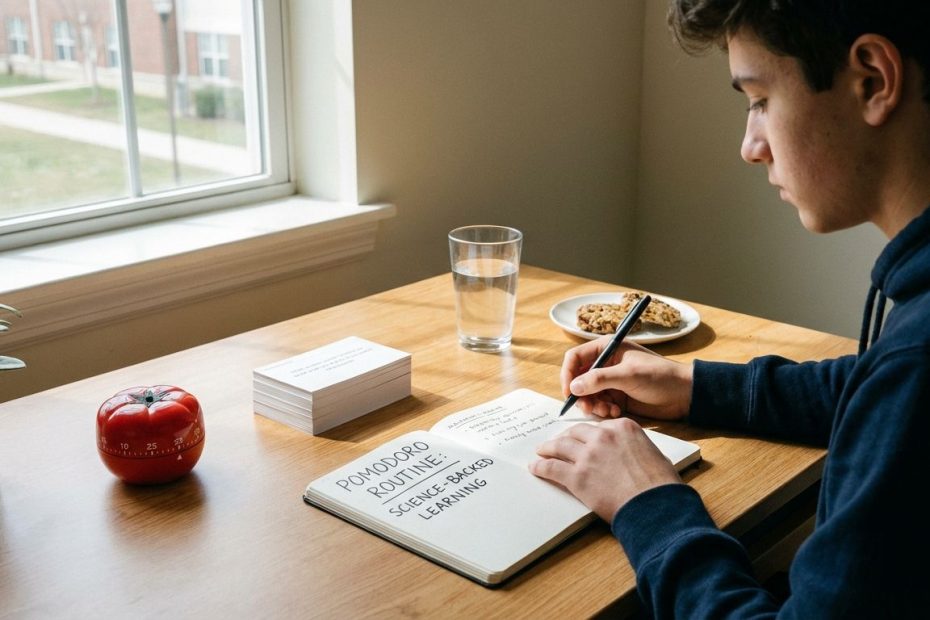
Pomodoro is a focus structure, not a learning method. It becomes powerful when the work inside each interval is retrieval-based, timed, and measurable. The main benefit is that it reduces avoidance and creates a clean start, which matters more than perfect motivation.
Use timing that matches the subject. For reading-heavy courses, 25/5 can keep energy steady. For math, chemistry, coding, and problem sets, 50/10 often works better because it reduces the cost of reloading context after every short break.
Define the unit of work inside a block. A strong Pomodoro block is “answer-first” work: closed-notes questions, a mini-quiz, a set of mixed problems, or a blank-page recall dump followed by checking. When the block ends, you should have a score, a list of errors, and a decision about what returns tomorrow.
Control breaks with rules that protect attention. A short break that turns into scrolling can destroy the next work block. If the device must stay nearby, place it face down and out of reach, and reserve it for a longer break after multiple cycles.
Track the number of completed cycles, not the number of hours “spent studying.” Cycles completed correlates with work finished and reduces the temptation to count low-quality time as progress.
What Should You Do If You Study A Lot But Still Forget Everything During Tests?
This problem usually comes from a mismatch between the way you practiced and the way the test asks for answers. Rereading, copying notes, and watching solution videos build recognition. Tests demand recall, selection of methods, and execution under time limits.
Repair the mismatch with a closed-notes practice loop. Start with a set of questions that reflect the test format, complete them without support, then check answers right away. When an error appears, write a short correction that captures the missing rule, the misread cue, or the broken step that caused the miss.
Then schedule re-testing. Put missed items into a “48-hour return” list and re-attempt them two or three days later, still closed-notes. This spacing forces the brain to retrieve under mild forgetting, which is where memory strengthens.
Add interleaving for subjects where problems look similar yet require different methods. Interleaving means mixing types in the same session: today’s concept, last week’s concept, and older material that still appears on cumulative exams. This trains the skill of choosing the right approach, a common reason students freeze during tests even when they “know the steps.”
Make the last week before a major test a performance phase, not a reading phase. Your calendar should show mostly timed sets, mixed sets, and correction review, with minimal new note-taking. When the test arrives, your brain recognizes the conditions because it has already been trained inside them.
How Do You Stay Focused With Your Phone And Social Media While Doing Homework?
Focus improves fastest when distraction is treated as an environment problem. If the phone stays within reach, attention will break repeatedly, and every break carries a restart cost. High school work often looks “easy,” yet it collapses under interruptions because reading comprehension and problem solving need sustained attention.
Control the room before controlling the mind. Place the phone in another room during work blocks, or lock it in a bag that stays zipped. If a device is required for assignments, enforce a one-tab policy and full-screen mode so attention has fewer escape routes.
Use clear rules that stay consistent across the semester. One practical set is: no social apps during blocks, messages checked only at the end of a cycle, entertainment saved for a planned window after the day’s core work is complete. This removes constant negotiation and makes the routine easier to follow.
Replace “break scrolling” with break behaviors that restore attention. Stand up, drink water, walk briefly, or reset the desk. These actions lower restlessness without pulling you into an attention trap that keeps the brain in rapid-switch mode.
If distraction persists, measure it. Write down the number of times the phone is picked up during a block for three days. The number often shocks students into taking environmental control seriously, and it gives a baseline to improve.
Best Study Method For Straight A’s In High School
- Daily: 2–4 Pomodoro cycles of closed-notes practice
- Weekly: spaced review, mixed problem sets, error log re-tests
- Nightly: 8–10 hours sleep for teens, devices off 30 minutes before bed
Make Your Grades Predictable, Not Stressful
Academic excellence becomes predictable when study time is built around retrieval practice, spaced review, and mixed practice that matches real test demands. A consistent schedule beats occasional marathon sessions because it turns learning into a weekly process, not a last-minute event. When sleep is protected, attention and memory stay reliable, and that reliability shows up as fewer careless errors and stronger recall under pressure. When the phone is controlled, each study block produces measurable output rather than fragmented effort. Commit to the system for three weeks, track performance on practice sets, and keep the loop tight: recall, check, fix, re-test.
References
- CDC, About Sleep (May 15, 2024)
- Dunlosky et al., Strengthening the Student Toolbox (AFT)
- Institute of Education Sciences / NCES, Interleaved Mathematics Practice
- Common Sense Media, Landmark Report Press Release
- Reddy et al., Unbounded Human Learning: Optimal Scheduling for Spaced Repetition (arXiv:1602.07032)
- Wikipedia, Spacing Effect
- WashU Medicine Research Profiles, Test-Enhanced Learning Publication Entry
- Reddit, r/studytips: “What is the best study technique?”
- Reddit, r/SGExams: “study schedule?”.